
Simplify, simplify.
Walk down the supplement aisle and magnesium looks like a whole family of different products: one for sleep, one for calm, one for muscle cramps, one for your brain. It's a great marketing story. Underneath it sits a real kernel of science — magnesium genuinely matters, and getting enough of it genuinely helps. What's been added on top is a promise the individual forms haven't yet earned. Once you can see which part is which, choosing a magnesium gets a lot simpler.
One thing to get straight first, because the labels never explain it: "form" here doesn't mean capsule, tablet, or powder — that's just packaging. It means what the magnesium is attached to. Magnesium never comes on its own; it's always paired with a partner molecule, which is why labels read magnesium citrate, magnesium glycinate, magnesium oxide. You'll see these pairings called salts — nothing to do with table salt, just the chemistry word for two things bonded together. That partner is what changes how well the magnesium absorbs, and how it sits in your stomach.
Start with the real question
Most people arrive asking "which magnesium is best for sleep?" — or for cramps, or for calm. It's a fair question, and it's the wrong one. The better question is: which form will my body actually absorb, and will my gut be happy with it?
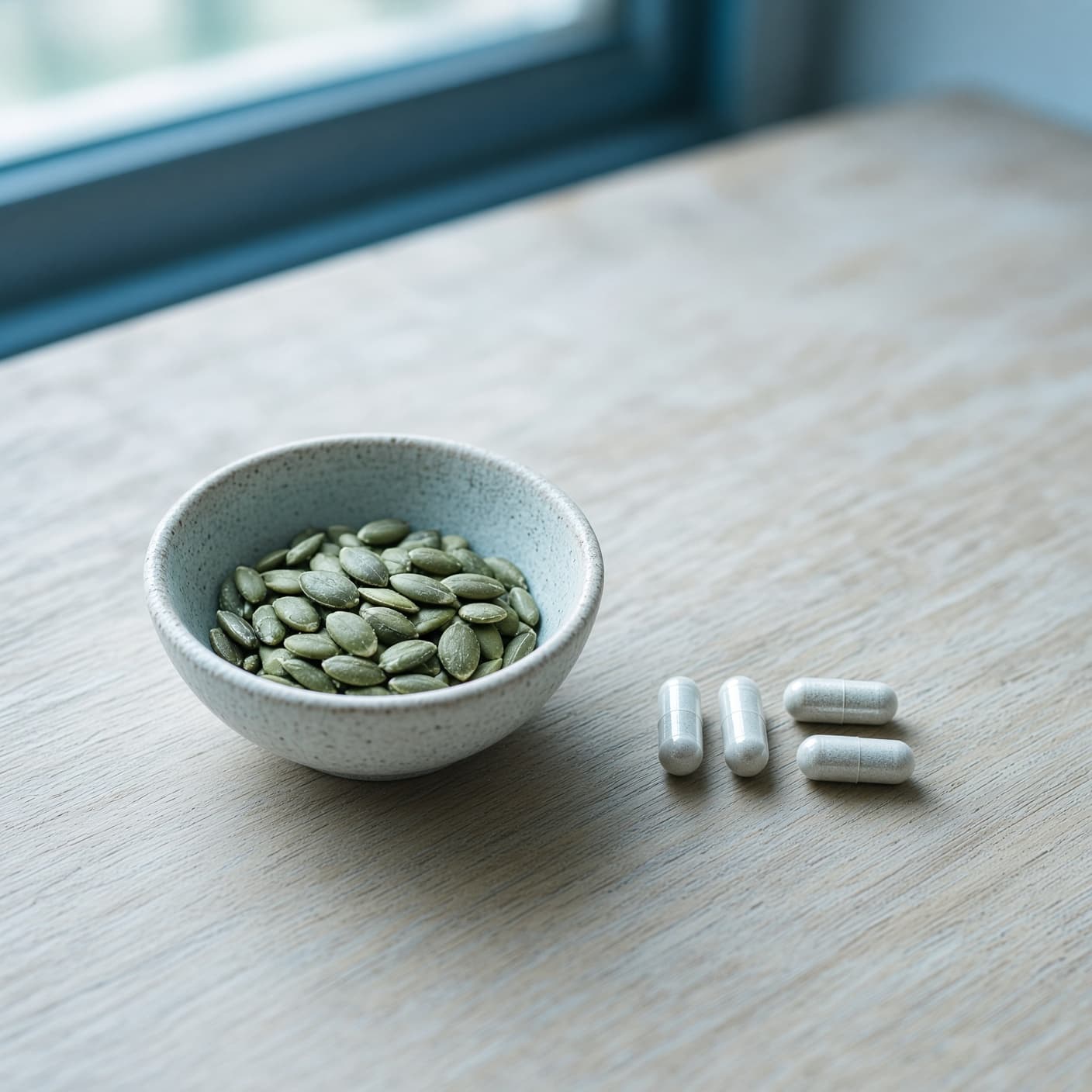
Whatever you're taking magnesium for, it usually comes down to the same two things: how much you absorb, and how well you tolerate it. Not a magic form, and the first place to look isn't a bottle at all: pumpkin seeds, spinach, almonds, black beans, legumes, and whole grains are all rich in magnesium.[1]
What actually differs: absorption and tolerability
About 30–40% of the magnesium you eat actually gets absorbed, and forms that dissolve easily in liquid absorb better than ones that don't.[1] Magnesium oxide is the notable laggard; magnesium citrate and several others comfortably beat it.[2][3] The table below lists every form you're likely to see on a label.
Here's the catch, though — and it's the single most useful thing in this article: how much you take, and how low you started, usually matter more than which salt it is. Under careful conditions the "better" forms are only slightly better.[4]
One reason is worth knowing: your gut can only take up so much magnesium at a time. Swallow a larger dose and a smaller share of it gets through — the rest simply stays in your intestine.[4] With that in mind:
| Form | Absorption | What it’s actually good for |
|---|---|---|
| Glycinate (bisglycinate) | Good | A fair default, and a fine one to land on. Its “gentle on the stomach” reputation is thin on head-to-head evidence, and the calm people report likely comes from getting enough magnesium (plus the glycine it’s bound to) rather than from something unique to this salt — a real effect, with a more ordinary explanation. |
| Citrate | Good | Well-absorbed and inexpensive. Can loosen stools at higher doses. |
| Malate, lactate, chloride, aspartate | Good | Reasonable options, all better absorbed than oxide. |
| Oxide | Poor (~4%) | Cheap and very magnesium-dense, but its real role is as a laxative or antacid — not an efficient way to top up your stores. |
| Sulfate (“Epsom salt”) | Not through skin | Lovely for a warm soak. A bath doesn’t reliably raise your magnesium — enjoy the relaxation, don’t count on it for repletion. |
| L-threonate | Good | The one form with a specific brain pitch, on a strong animal rationale. Human thinking-and-memory evidence is small and often maker-funded — a maybe, not a proven brain booster. |
Glycinate (bisglycinate)
- Absorption
- Good
- What it’s actually good for
- A fair default, and a fine one to land on. Its “gentle on the stomach” reputation is thin on head-to-head evidence, and the calm people report likely comes from getting enough magnesium (plus the glycine it’s bound to) rather than from something unique to this salt — a real effect, with a more ordinary explanation.
Citrate
- Absorption
- Good
- What it’s actually good for
- Well-absorbed and inexpensive. Can loosen stools at higher doses.
Malate, lactate, chloride, aspartate
- Absorption
- Good
- What it’s actually good for
- Reasonable options, all better absorbed than oxide.
Oxide
- Absorption
- Poor (~4%)
- What it’s actually good for
- Cheap and very magnesium-dense, but its real role is as a laxative or antacid — not an efficient way to top up your stores.
Sulfate (“Epsom salt”)
- Absorption
- Not through skin
- What it’s actually good for
- Lovely for a warm soak. A bath doesn’t reliably raise your magnesium — enjoy the relaxation, don’t count on it for repletion.
L-threonate
- Absorption
- Good
- What it’s actually good for
- The one form with a specific brain pitch, on a strong animal rationale. Human thinking-and-memory evidence is small and often maker-funded — a maybe, not a proven brain booster.
Sources for this table: citrate vs oxide[2]; oxide’s ~4% absorption[3]; Epsom / transdermal[5]; L-threonate[6].
The useful question isn't "which form cures what." It's "which one absorbs well and sits fine in my gut."
Here's why a small result in a study can still matter to you. Say ten people try magnesium, but only two of them were low to begin with. Those two feel a real difference. The other eight already had plenty, so they feel nothing. Average all ten together and the result looks small — even though for two people it mattered.[4] If your own intake has been low, you might be one of the two. Correcting a shortfall with any well-absorbed, well-tolerated form stays a low-cost experiment worth considering.
Magnesium oxide really is a laxative
Most "this form, that purpose" claims are marketing. This one isn't. Magnesium oxide really does relieve occasional constipation — and so does magnesium citrate, if you take enough of it. The reason goes back to absorption: whatever your gut doesn't take up stays in your intestine. Sitting there, it draws in water, and that extra water is what softens things and gets them moving.[7]
That's how one mineral ends up looking like two different products. Magnesium oxide is poorly absorbed at any dose, so most of it always reaches the intestine — which is why it's sold as a laxative. Magnesium citrate absorbs well at ordinary doses, so most of it never gets that far. Take a lot at once, though, and the surplus does exactly what the oxide does.
Safety note: this isn't a treatment plan. If constipation is a regular issue, consult your clinician.
Sleep, heart, energy: what the trials actually show
"Glycinate for sleep." "Taurate for the heart." "Malate for energy." Tidy labels, each with a story that sounds convincing. Look at the actual trials, though, and the promises thin out fast:
- Glycinate for sleep rests on one small 2025 trial, paid for by people with a commercial interest in the answer. Sleep did improve — a little. But glycinate was never compared against any other form of magnesium, so the trial can't answer the question that actually matters: is glycinate better than a cheaper one?[8] The wider research points the same way — people fall asleep about 17 minutes sooner, with no change in how long they stay asleep — and those studies weren't especially well run either.[18]
- Taurate for the heart is an idea from animal studies. No proper human trial has tested the form itself.[9]
- Malate for energy was tested once, in people with fibromyalgia. In the part of the trial where nobody knew who was getting the real thing, it made no difference.[10]
**And if you sleep better on glycinate — it wasn't a placebo effect. ** You may simply have been low on magnesium and fixed it; its role in normal muscle, nerve and energy function is well established.[1] What the trials don't support is the idea that one particular magnesium salt has a power the others don't — which is why there is rarely a reason to pay a premium for one.
How much — and how to stay safe
- Aim (total, food + supplements): the Recommended Dietary Allowance runs roughly 310–420 mg a day for adults, depending on age and sex.[1]
- The supplement ceiling: the Tolerable Upper Intake Level for magnesium from supplements and medications is 350 mg a day — and note, magnesium from food isn't counted toward that limit.[1] Most people don't need a mega-dose to fill a gap.
- Your built-in feedback: loose stools are the classic sign you've taken more than your gut wants — ease off or switch to a gentler form.
- Check with a clinician first if you have reduced kidney function, are pregnant or nursing, or take multiple medications — magnesium can build up or interact, and this is where self-dosing gets risky.
- Don't chase a lab number: routine serum levels have "little correlation with total body magnesium levels or concentrations in specific tissues," so a blood test is a poor stand-alone gauge.[1]
What magnesium can and can't do for migraines, blood sugar, and bones
You'll see magnesium sold as a fix for migraines, blood sugar, and bone loss. There are two halves to this, and you need both.
The supportive half. Combine the trials and magnesium does reduce how often migraines come and how bad they are,[12] and a review of those reviews rates that evidence as strong.[13] Not everyone agrees — another review calls magnesium possibly effective for preventing migraines rather than proven,[17] which is a fair picture of evidence that is real but still settling. The trials also show small drops in blood pressure — a couple of points, and more in people who start out with high blood pressure or low magnesium[14] — and better blood-sugar control in people with type 2 diabetes.[15] These are real signals.
The limiting half. The effects are small, many of the studies were small or short, and none of it is strong enough to call magnesium a treatment. Bone outcomes still need more research.[11] And the findings don't all run in magnesium's favor: the Cochrane review of magnesium for ordinary muscle cramps found no clinically meaningful benefit — worth saying plainly, precisely because cramps are one of the aisle's most confident promises.[16]
All of these are medical conditions, and decisions about them belong with your clinician — not a supplement label, and not an article. What magnesium reliably does is support normal muscle and nerve function, energy metabolism, and everyday blood-pressure and blood-sugar regulation.[1] That's a different thing from treating a disease.
The bottom line
You don't need the whole shelf of specialized magnesiums — one good one will do. Pick a well-absorbed form you tolerate — glycinate or citrate are sensible defaults — keep the dose modest, and lean on food first. When a label promises a different form for every symptom, trust the mineral more than the promise.
Magnesium is a genuinely useful mineral. If your intake is low, or you have symptoms you're trying to address, filling that gap with a form that absorbs well and sits comfortably is a reasonable, low-risk step — and it doesn't need any hype.
For the rarer case — a supplement where the evidence really is strong, and the scary story about it turns out to be a misread lab number — see Creatine: Strength, the Brain, and That Kidney Number.
References
- 1.
NIH Office of Dietary Supplements — Magnesium: Fact Sheet for Health Professionals. Absorption (~30–40% of dietary magnesium; soluble forms absorbed more completely), food sources, RDA (~310–420 mg/day for adults), the supplemental/medication Upper Limit of 350 mg/day (food magnesium not counted), and the note that serum magnesium correlates poorly with total body stores. https://ods.od.nih.gov/factsheets/Magnesium-HealthProfessional/
↩ - 2.
Comparative absorption: magnesium citrate is absorbed better than oxide. Lindberg JS, Zobitz MM, Poindexter JR, Pak CY. J Am Coll Nutr. 1990;9(1):48–55. PMID 2407766. Walker AF, Marakis G, Christie S, Byng M. Magnes Res. 2003;16(3):183–191. PMID 14596323 — the latter tested an amino-acid–chelated form, not confirmed as modern "glycinate," so the two are not equated here). Human load / marker studies.
↩ - 3.
Firoz M, Graber M. Bioavailability of US commercial magnesium preparations. Magnes Res. 2001;14(4):257–262. PMID 11794633. Magnesium oxide fractional absorption is poor (~4% in a commercial-prep study), while chloride, lactate, and aspartate are absorbed more completely than oxide. Human urine-increment method.
↩ - 4.
Schuchardt JP, Hahn A. Intestinal Absorption and Factors Influencing Bioavailability of Magnesium — An Update. Curr Nutr Food Sci. 2017;13(4):260–278. PMID 29123461. Organic salts are only slightly better absorbed than inorganic under standardized conditions; dose and baseline magnesium status often matter more than the salt form. Magnesium is taken up by a saturable active pathway (TRPM6/7 channels) alongside passive paracellular diffusion, so bioavailability varies with the dose — the fraction absorbed falls as the amount taken in one go rises. Cited here for the dose-dependence point; note that the NIH ODS fact sheet (ref 1) gives the ~30–40% figure but does not itself address dose-dependence, so that claim rests on this reference. (Supported by SR PMID 34111673.)
↩ - 5.
Gröber U, Werner T, Vormann J, Kisters K. Myth or Reality — Transdermal Magnesium? Nutrients. 2017;9(8):813. PMID 28788060. (See also Gröber U, Schmidt J, Kisters K. Magnesium in Prevention and Therapy. Nutrients. 2015;7(9):8199–8226.) Transdermal / Epsom-bath magnesium is scientifically unsupported as a reliable way to raise magnesium status (skin permeation ≠ meaningful repletion).
↩ - 6.
Liu et al. 2016, the MMFS-01 trial (PMID 26519439). Magnesium-L-threonate human cognition trials are small and frequently industry-funded, on a strong animal rationale; human cognitive-outcome evidence is PRELIMINARY.
↩ - 7.
Magnesium oxide (and high-dose citrate) act as osmotic laxatives — a guideline-recognized effect (AGA/ACG 2023 guidance and supporting trials; PMID 37211380; 32969946). Cited as education about the osmotic effect, not a treatment claim for a bowel disorder.
↩ - 8.
Schuster et al. 2025 (PMID 40918053). Randomized trial of magnesium bisglycinate for sleep: Insomnia Severity Index −3.9 vs −2.3 on placebo, effect size ≈ 0.2, with industry-adjacent funding and no comparison against other magnesium forms.
↩ - 9.
McCarty 1996 (PMID 8692051). Magnesium taurate cardiovascular claims rest on hypothesis and animal work, not form-specific human RCTs (see also a 2026 single-arm combination-product report, PMID 42439043).
↩ - 10.
Russell et al. 1995, the controlled "Super Malic" trial (PMID 8587088): magnesium malate for fibromyalgia was null at the blinded low dose.
↩ - 11.
NIH Office of Dietary Supplements — Magnesium: Fact Sheet for Health Professionals, health-outcomes sections: migraine evidence limited with modest reductions; type-2-diabetes/glycemic trials conflicting/insufficient; osteoporosis "more research is needed." Cited to show these are held as unsettled, not treatment claims. https://ods.od.nih.gov/factsheets/Magnesium-HealthProfessional/
↩ - 12.
Chiu HY, Yeh TH, Huang YC, Chen PY. Effects of Intravenous and Oral Magnesium on Reducing Migraine: A Meta-analysis of Randomized Controlled Trials. Pain Physician. 2016;19(1):E97–E112. PMID 26752497. 21 RCTs; oral magnesium reduced migraine frequency and intensity. Reported as evidence, not as a treatment recommendation.
↩ - 13.
Veronese N, Demurtas J, Pesolillo G, et al. Magnesium and health outcomes: an umbrella review of systematic reviews and meta-analyses of observational and intervention studies. Eur J Nutr. 2020;59(1):263–272. PMID 30684032. doi:10.1007/s00394-019-01905-w. Grades the randomized evidence for reduced migraine frequency/intensity as strong.
↩ - 14.
Zhang X, Li Y, Del Gobbo LC, et al. Effects of Magnesium Supplementation on Blood Pressure: A Meta-Analysis of Randomized Double-Blind Placebo-Controlled Trials. Hypertension. 2016;68(3):660–669. Modest pooled reductions, larger in hypertensive and low-magnesium groups. Structure/function context only — not a hypertension treatment claim.
↩ - 15.
Xu L, et al. Effects of magnesium supplementation on improving hyperglycemia, hypercholesterolemia, and hypertension in type 2 diabetes: a pooled analysis of 24 randomized controlled trials. Front Nutr. 2023;9:1020327. PMID 36741996. Reductions in fasting plasma glucose and HbA1c in type 2 diabetes. Reported as evidence; management of diabetes belongs with a clinician.
↩ - 16.
Garrison SR, Korownyk CS, Kolber MR, Allan GM, Musini VM, Sekhon RK, Dugré N. Magnesium for skeletal muscle cramps. Cochrane Database Syst Rev. 2020;9(9):CD009402. PMID 32956536. doi:10.1002/14651858.CD009402.pub3. Idiopathic (largely older-adult nocturnal) cramps: no clinically meaningful benefit, moderate certainty. Included deliberately as a negative finding that cuts against a common marketing claim.
↩ - 17.
von Luckner A, Riederer F. Magnesium in Migraine Prophylaxis — Is There an Evidence-Based Rationale? A Systematic Review. Headache. 2018;58(2):199–209. PMID 29131326. Rates magnesium for migraine prophylaxis as possibly effective rather than established — included deliberately alongside refs 12 and 13 so the reader sees that reviewers of the same literature do not all land in the same place.
↩ - 18.
Mah J, Pitre T. Oral magnesium supplementation for insomnia in older adults: a systematic review and meta-analysis. BMC Complement Med Ther. 2021;21(1):125. PMID 33865376. doi:10.1186/s12906-021-03297-z. Three RCTs, n=151: sleep-onset latency −17.36 min (95% CI −27.27 to −7.44); total sleep time non-significant; all trials at moderate-to-high risk of bias, low-to-very-low certainty. See also Arab A, Rafie N, Amani R, Shirani F. The Role of Magnesium in Sleep Health: a Systematic Review of Available Literature. Biol Trace Elem Res. 2023;201(1):121–128. PMID 35184264 — observational association stronger than the randomized evidence.
↩