
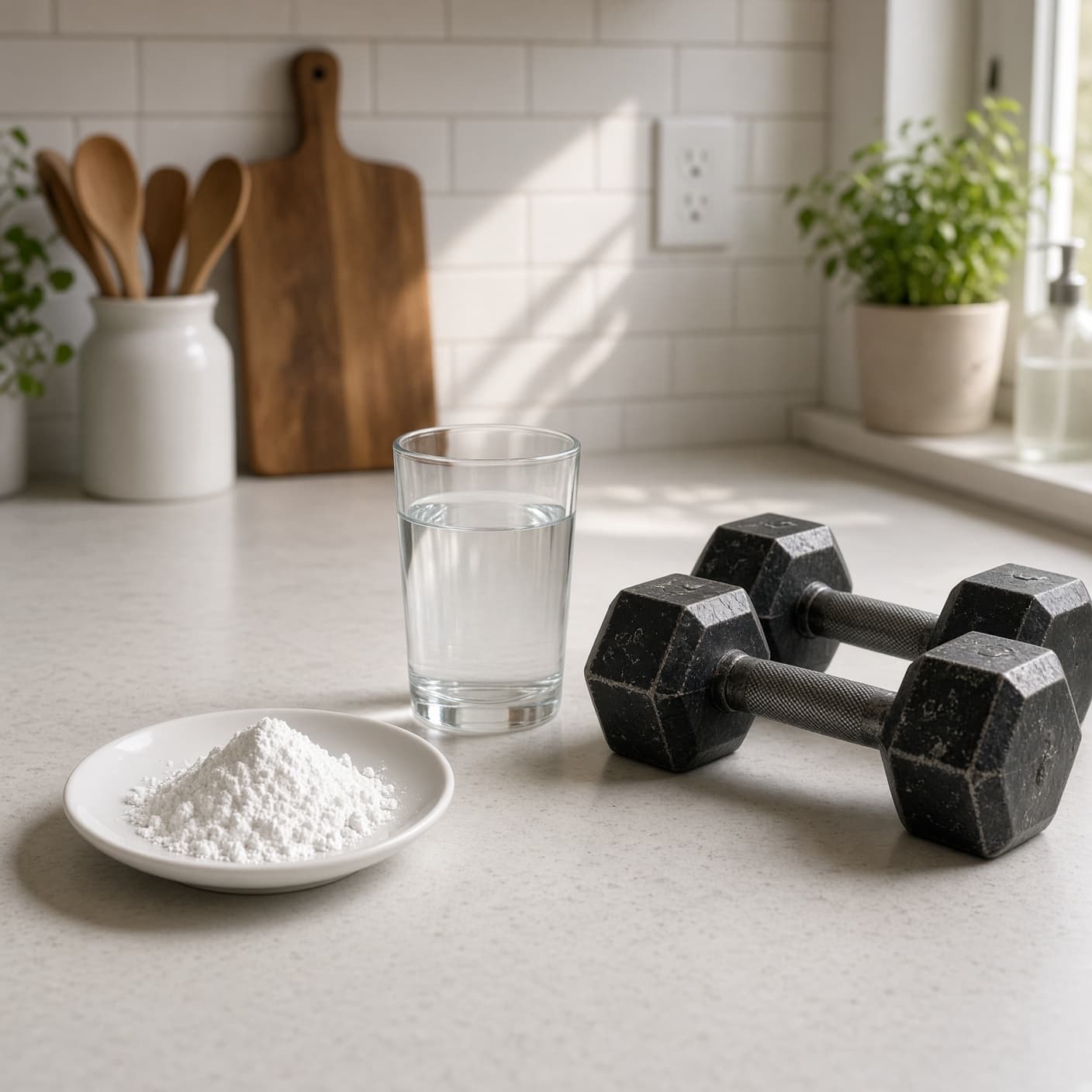
Many supplements offer lofty promises and little proof. Creatine is the rare exception — a genuinely strong track record for strength, promising research on the brain, and a myth about your kidneys that won't quite die.
What creatine is
Creatine is not exotic. Your body makes it from three amino acids, and you also eat it — mostly in meat and fish. Most of what you have is stored in muscle as phosphocreatine, a small, fast-recharging energy reserve.
When you do something short and hard — a sprint, a heavy lift, a jump — your muscles burn through their immediate fuel in seconds. Phosphocreatine's job is to rebuild that fuel almost instantly so you can keep going. Supplementing creatine raises the amount stored in muscle. It is not a stimulant, a hormone, or anything steroid-like. It tops up a reserve your cells already use.[1][9]
Creatine is a normal compound your body already makes and stores. Supplementing it fills a fast muscle-energy reserve.
Why it matters
The reserve only helps if you actually use it. That is why the strongest evidence is not "creatine builds muscle by itself." It is: creatine plus hard training produces a bit more strength and power than the same training without it.
A 2025 meta-analysis of 69 randomized trials in about 1,900 adults found that creatine with resistance training added small but measurable gains over training plus placebo: about +1.4 kg on the bench or chest press, +5.6 kg on the squat, +1.5 cm on the vertical jump, and about +48 watts of peak cycling power.[2] Those kilograms sit on top of training, not instead of it. The same position-stand literature extends that picture to lean mass gained during training.[1]
Two things those numbers do not say. First, the gains show up with training. There is no evidence that creatine builds muscle from the couch.[1][9] Second, the effects are small and uneven across lifts. It is a helper for strength and high-intensity work, not an endurance drug and not a guaranteed change in how you look.
Who benefits from supplementation
The people most likely to notice a difference are the people who start with more room to fill the reserve, or who actually use that reserve in training.
People who lift or train for power. This is the settled case. If you are already doing resistance or high-intensity work, creatine is one of the few supplements with enough trials behind it to treat as a real training aid.[1][2][9]
Older adults who are also lifting. A meta-analysis covered 357 older adults, average age about 64. With resistance training, creatine increased fat-free mass. It also improved chest-press and leg-press strength, and how quickly people could stand from a chair, more than training plus placebo.[3]
Postmenopausal women who lift and take enough. The most specific picture is a 2026 review of seven trials (mean age about 62). Creatine at 5 grams a day or more, paired with resistance training, added +0.37 kg of lean mass and +7.5 kg on the leg press. Lower doses without training showed no effect.[10] The dose and the lifting do the work together, or not at all.
People who get less creatine from food. The effect tends to show up most in people who start with less — older adults and vegetarians. In vegetarians, a six-week trial of 5 grams a day improved working memory and a timed thinking task.[6] In older adults, memory studies find a clearer benefit than they do in the young.[4]
The brain: a smaller, earlier story
Muscle creatine is the settled chapter. Brain creatine is still being written. The brain is energy-hungry, and creatine plays a role in that supply. A 2023 memory review found a benefit in older adults (ages 66–76) and none in younger people (ages 11–31). After the authors corrected a double-counting error, the overall effect, across all ages, was no longer significant.[4]
One 2024 crossover trial gave fifteen young adults a single high dose of creatine monohydrate (0.35 g per kilogram) during 21 hours of sleep deprivation. The authors reported that this dose partially reversed fatigue-related cognitive decline, with the strongest effect four hours after the dose and an effect lasting up to nine hours.[5] They also noted that the right dose and the exact timing still need to be determined.
Hold the brain story at its real size: a signal in older adults, and one early high-dose trial under sleep loss. Not an everyday brain booster.
Creatine and your kidneys
The scare is that creatine "wrecks your kidneys." What actually happens is simpler. Doctors often estimate kidney function from a blood marker called creatinine. Creatinine is the normal breakdown product of creatine. When you take more creatine, that marker can rise. On a lab report, it can look as if the kidneys are under strain.[7]
When researchers measure how well the kidneys actually filter — glomerular filtration rate, the direct test rather than the creatinine stand-in — healthy people taking creatine show no meaningful change.[8] The number moved. In healthy kidneys, the organ did not.
That finding is not a blank check. The trials are in people with healthy kidneys. If you have known or at-risk kidney disease, reduced kidney function, a single kidney, or an unexplained rising creatinine, this is a clinician conversation first — not an assumption that "it's only the creatine."[7][8]
What the studies typically use
This is what the research used. It is not a personal plan.
- Form. Creatine monohydrate is the standard — the most studied, effective, and inexpensive form. Fancier versions (HCl, "buffered," ethyl ester) have not been shown to beat it.[9]
- Amount. Most trials use either a short loading week (about 20 g a day, split into four doses, for 5–7 days) or a steady 3–5 g a day. Loading fills the reserve faster. It is not required.[9]
- Comfort. Large single doses can upset the stomach and add a little temporary water weight. Split the dose and take it with fluid and food.[9]
- Quality. Choose a third-party-tested product. "Supplement" does not mean "checked for purity."
For the curious. That early-retention pattern was first mapped in 1926. Chanutin and Guy took the creatine themselves — 10 grams a day, and for a stretch 20 grams — over several weeks. In the first few days the body kept most of what they swallowed. As the days went on, more of each new dose passed into the urine.[11] Later work with muscle biopsies turned that same pattern into the optional loading week used in modern trials: a faster way to fill the same reserve, not a different result.
The same "which form should I buy?" question is even noisier with magnesium. That story is in Magnesium: What Its Many Forms Actually Do.
Creatine monohydrate is the standard — the most studied, effective, and inexpensive form.
Who should check with a clinician first
Talk to a clinician first if any of these apply. You are pregnant or trying to conceive. It is for a teenager. You have kidney concerns or take several medications. You are considering it for a mood or neurological condition. Those last uses are active research, not something to self-treat.[1][9]
The bottom line
Creatine is a normal compound your body already makes and stores. Supplementing it fills a fast muscle-energy reserve. That reserve pays off most for people who train hard, for older adults who lift, and for people who start with less of it in their diet. The brain evidence is a signal in older adults, plus one early high-dose trial under sleep loss — not a general memory effect. The kidney scare, in healthy people, is mostly a lab-marker mix-up.
Used as the studies used it — plain monohydrate, a few grams a day, with training if strength is the goal — it is one of the few supplements whose reputation matches what the trials actually show. Not magic. Not a shortcut. Not a treatment for disease.
References
References
- 1.
Kreider RB, Kalman DS, Antonio J, et al. International Society of Sports Nutrition position stand: safety and efficacy of creatine supplementation in exercise, sport, and medicine. J Int Soc Sports Nutr. 2017;14:18. PMID 28615996. doi:10.1186/s12970-017-0173-z. Performance, lean mass during training, and safety in healthy people.
↩ - 2.
Kazeminasab F, Kerchi AB, Sharafifard F, Zarreh M, Forbes SC, Camera DM. The effects of creatine supplementation on upper- and lower-body strength and power: a systematic review and meta-analysis. Nutrients. 2025;17(17):2748. PMID 40944139. 69 trials, 1,937 adults; small gains in bench/chest press (WMD 1.43 kg), squat (5.64 kg), vertical jump (1.48 cm) and Wingate peak power (47.81 W) with creatine plus resistance training, with age, sex and training status examined as subgroups rather than restrictions.
↩ - 3.
Devries MC, Phillips SM. Creatine supplementation during resistance training in older adults — a meta-analysis. Med Sci Sports Exerc. 2014;46(6):1194–1203. PMID 24576864. doi:10.1249/MSS.0000000000000220. Creatine plus training, not creatine alone.
↩ - 4.
Prokopidis K, Giannos P, Triantafyllidis KK, Kechagias KS, Forbes SC, Candow DG. Effects of creatine supplementation on memory in healthy individuals: a systematic review and meta-analysis of randomized controlled trials. Nutr Rev. 2023;81(4):416–427. PMID 35984306. doi:10.1093/nutrit/nuac064. The original pooled SMD of 0.29 was withdrawn after the authors corrected double-counting (authors' reply, Nutr Rev. 2023;81(11):1497, PMID 36644912): overall SMD 0.19, P = 0.15. The older-adult subgroup (66–76 years) remained significant (SMD 0.80); younger participants (11–31 years) did not (SMD 0.02).
↩ - 5.
Gordji-Nejad A, Matusch A, Kleedörfer S, et al. Single dose creatine improves cognitive performance and induces changes in cerebral high energy phosphates during sleep deprivation. Sci Rep. 2024;14:4937. PMID 38418482. doi:10.1038/s41598-024-54249-9. n = 15 young adults, crossover; 0.35 g/kg single dose during 21-hour sleep deprivation. Authors: partial reversal of fatigue-related cognitive decline; peak about 4 h, lasting up to 9 h; dose and timing still to be determined.
↩ - 6.
Rae C, Digney AL, McEwan SR, Bates TC. Oral creatine monohydrate supplementation improves brain performance: a double-blind, placebo-controlled, cross-over trial. Proc Biol Sci. 2003;270(1529):2147–2150. PMID 14561278. doi:10.1098/rspb.2003.2492. 45 young vegetarian adults; 5 g/day for six weeks.
↩ - 7.
Longobardi I, et al. Is it time for a requiem for creatine supplementation-induced kidney failure? A narrative review. Nutrients. 2023;15(6):1466. PMID 36986197. Serum creatinine can rise as a breakdown product; reliable kidney-function methods do not show damage in healthy people. Data in pre-existing kidney disease remain limited.
↩ - 8.
Naeini EK, Eskandari M, Mortazavi M, Gholaminejad A, Karevan N. Effect of creatine supplementation on kidney function: a systematic review and meta-analysis. BMC Nephrol. 2025;26:622. PMID 41199218. doi:10.1186/s12882-025-04558-6. Modest rise in serum creatinine; no significant change in GFR.
↩ - 9.
Antonio J, Candow DG, Forbes SC, et al. Common questions and misconceptions about creatine supplementation: what does the scientific evidence really show? J Int Soc Sports Nutr. 2021;18:13. PMID 33557850. doi:10.1186/s12970-021-00412-w. Monohydrate as the reference form; loading optional; well tolerated at 3–5 g/day in healthy adults; steroid-like and no-training claims unsupported.
↩ - 10.
Naddafha S, Antonio J, Kreider RB, Stout JR. Creatine monohydrate for lean mass, strength, and bone density in postmenopausal women: a systematic review and meta-analysis. J Int Soc Sports Nutr. 2026;23(1):2668435. PMID 42141930. doi:10.1080/15502783.2026.2668435. Seven trials; +0.37 kg lean mass and +7.5 kg leg press with ≥5 g/day plus resistance training. Bone-density outcomes are not used here as a treatment claim.
↩ - 11.
Chanutin A, Guy LP. The fate of creatine when administered to man. J Biol Chem. 1926;67(1):29–41. The writers were the subjects. L.P.G.: 10 g/day for 34 days. A.C.: 10 g/day, then 20 g/day. Experimental periods 29 and 44 days (250 g and 340 g ingested). "During the first few days of creatine feeding its retention by the body is striking. A gradual decrease in retention may be noted… as the experiment proceeds." The modern 20 g loading week was formalized later with muscle biopsies (Harris et al., 1992).
↩