

Have you ever noticed the way that one long, slow exhale can soften your shoulders before you've even decided to relax? You sigh, and something lets go — the jaw, held breath, tension in your chest, the grip of a racing thought. You didn't talk yourself into it. Your body did it for you.
That small, involuntary moment is pointing to a doorway. Most of what your nervous system does — your heartbeat, your digestion, the tension humming in your muscles — runs in the background without asking your permission. But breath is different. It runs on its own and it answers to you. It's the one automatic system you can take hold of, like a dial you can turn by hand, while the rest of the body listens.
The breath's influence matters today as much as it ever could. So many people move through days of low-grade, but accumulating, stress — shallow chest-breathing at a desk, shoulders hunched or near the ears, a sense of being slightly braced against nearly everything. Over months and years, that bracing shows up as poor sleep, fatigue, persistent tension, a short fuse, a body that never quite feels safe to rest. The good news is that your body is plastic, meaning it can adapt and reorganize in astounding ways, and your ability to tap into and direct this potential is only a breath away.
Here's what we'll explore together: why a slow exhale settles the body, the simple physiology that makes it work, and three small practices you can try in the next few minutes — and keep for the rest of your life.
Your breath is the body's master volume knob
Picture a volume knob. Turn it one way and the body's "go" system rises — alert, ready, primed. Turn it the other way and the "rest" system comes forward — slower, softer, more open to digesting, healing, and connecting. In the language of physiology, those are the two branches of the autonomic nervous system: the sympathetic ("fight or flight") and the parasympathetic ("rest and digest").
Here is the quietly remarkable part: your breath turns the knob in our metaphor, and the in-breath and the out-breath turn it in opposite directions. When you breathe in, your heart speeds up a little and the "go" branch nudges upward. When you breathe out — especially a long, unhurried out-breath — the "rest" branch comes forward and your heart slows. You can feel this if you place a hand on your chest and breathe slowly: a gentle rise on the inhale, a settling on the exhale.
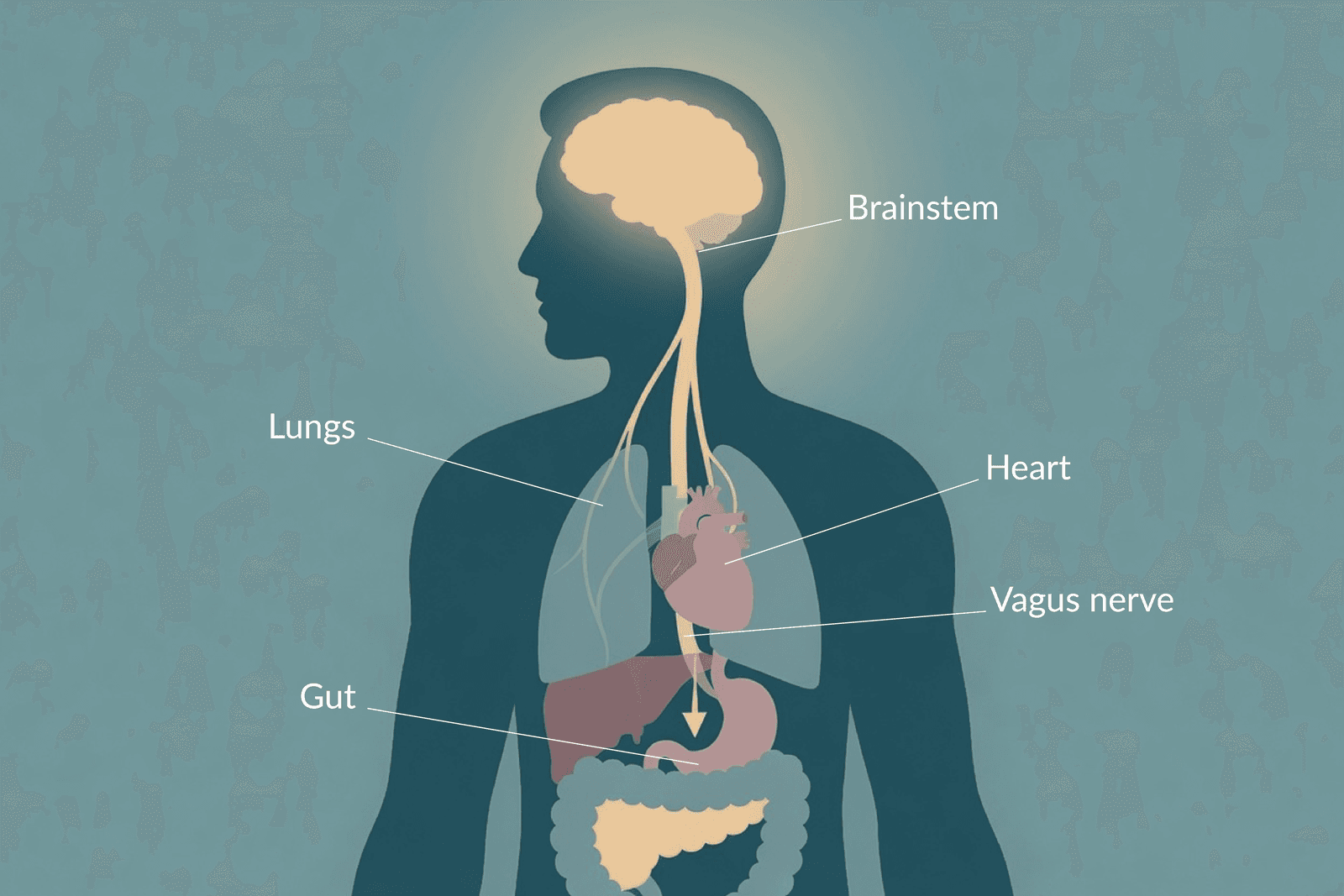
The messenger doing much of this work is the vagus nerve — a long, wandering nerve that connects the brainstem to the heart, lungs, gut, and more. A lengthened exhale is one of the most direct ways to stimulate it, which is why "just breathe" is more than a figure of speech: a slow out-breath is a physical signal telling the body and especially the heart it's alright to ease off.
The science, in plain language
Researchers have a precise way to watch this happening, and it's worth knowing about because you can eventually feel it for yourself.
When you breathe slowly, your heart rate naturally rises and falls with the breath — up on the inhale, down on the exhale. That rhythmic dance is called respiratory sinus arrhythmia, and a heart that flexes this way is a sign of a responsive, well-regulated nervous system.[1] The overall variation in the gaps between heartbeats is measured as heart rate variability (HRV) — and counterintuitively, more variability tends to reflect a body that can shift gears smoothly between effort and rest.
Slow breathing reliably increases this kind of variability and the activity of the vagus nerve. A systematic review of slow-breathing research found consistent shifts toward parasympathetic ("rest") activity and reports of greater calm and alertness.[2] In other words, the felt sense of "I feel steadier" has a measurable physiological signature underneath it.
There's also a useful frame from polyvagal theory, which describes how the nervous system is always quietly scanning for cues of safety or threat — and how a calm physiology opens the door to feeling connected and socially at ease rather than guarded.[3] Breath is one of the clearest "safety cues" you can send your own system from the inside. As Stephen Porges, the researcher who developed polyvagal theory, has put it: "Safety is the treatment."
Breath is the bridge which connects life to consciousness, which unites your body to your thoughts.
You don't need to memorize any of these terms. They're simply the map. The territory is the breath in your own body — so let's visit it.
Three small practices (try one right now)
Be sure to put the new knowledge into action by performing these after reading each of them. Each takes under two minutes. There's nothing to strive after and no way to do it wrong — you're simply sending a signal to the body that it knows how to receive and witnessing the response.
What change(s) did you observe? Many people feel a small drop in their shoulders, or a single clearer breath. That's the volume knob turning.
The next one is less of a reset and more of a settling — a rhythm you can rest into for a minute or two.
The last one isn't about changing the breath at all. While that may sound cliché, it can be more challenging than most people realize. It's about finding it — because awareness alone begins the process to settle the system.
Weaving it into a real life
A single calm breath is lovely. The deeper gift arises from repetition — from your body learning, over many small moments, that it's allowed to come down from high alert. Research into slow breathing and HRV consistently points the same direction: the people who practice tend to find it easier to settle, to sleep, and to recover from stress over time.[2] This is reconditioning, not a quick fix — and like any practice, it rewards you for showing up for practice more than getting it perfect.
Many people find these practices to be a powerfully supportive complement in their care for stress, tense muscles, restless sleep, or a busy mind. (To be clear, breathwork is an essential addition to — not a replacement for — medical care; if you're managing a health condition, keep your clinician in the loop, and skip any practice that feels dizzying or uncomfortable.)
If you'd like a gentle on-ramp, here's a seven-day experiment:
- Pick one anchor — a moment that already happens daily (the first minute at your desk, a red traffic light, the pause before a meal).
- Attach one practice to it — usually the longer exhale or a physiological sigh.
- Keep it small — three to five slow breaths is plenty.
- Notice, don't judge — afterward, be curious about what you notice, if anything. Curiosity beats discipline here.
That's it. Be sure you're not adding something that feels like a chore; modify your practice until you can feel the same as if you were giving something special to someone you love. (Later in this series, we'll look at how tools like real-time biofeedback let you watch your HRV respond — a satisfying way to see the volume knob move.)
A quiet kind of sovereignty
In a world that often asks you to hand your attention and your calm to whatever is loudest, the breath is a patient, steady form of self-governance. No app, no subscription, no permission required — just a capacity that's always present, all yours, right now.
Within you there is a stillness and a sanctuary to which you can retreat at any time and be yourself.
To breathe on purpose is to remember that you have a say in your own inner weather. Not control over everything — but a hand on the dial. That's a good place to begin, and it's always within reach.
References
- 1.
Shaffer, F., & Ginsberg, J. P. (2017). An Overview of Heart Rate Variability Metrics and Norms. Frontiers in Public Health, 5, 258.
↩ - 2.
Zaccaro, A., et al. (2018). How Breath-Control Can Change Your Life: A Systematic Review on Psycho-Physiological Correlates of Slow Breathing. Frontiers in Human Neuroscience, 12, 353.
↩ - 3.
Porges, S. W. (2011). The Polyvagal Theory: Neurophysiological Foundations of Emotions, Attachment, Communication, and Self-Regulation. W. W. Norton.
↩ - 4.
Balban, M. Y., et al. (2023). Brief structured respiration practices enhance mood and reduce physiological arousal. Cell Reports Medicine, 4(1), 100895.
↩